Saturday, October 30, 2010

Constructing a residence fit for the President of the University of Limerick


Last February a statement on behalf of the President of the University of Limerick to the Public Accounts Committee indicated that €2,317,000 was provided by The Atlantic Philanthropies towards the complete cost of constructing an official home for the President on the campus, of which €347,000 was for associated infrastructure.


The Atlantic Philanthropies have been extraordinarily generous to the University of Limerick and provided grants of €29.65 million towards 15 different projects in the past decade. These included the funding of €3.61 million for a faculty and staff common room in 2001 and €1,075 million for core support for the University of Limerick Foundation in 2007. But the latest list of grant-aided projects does not mention the Presidents House, despite other grants being paid to the University in 2009.


Perhaps, Chuck Feeney, the founder of The Atlantic Philanthropies made the funds available through some other means. However, the statement to the Public Accounts Committee emphasised that the Higher Education Authority had been very supportive of campus development and had been regularly briefed 'in the context of seeking State funds for campus development through various submissions and reports'. But it did not explicitly state the Higher Education Authority or the Department of Education & Skills were aware of the initiative to build the President's House before this matter was discussed at the Public Accounts Committee. Would it not have been astute of the University to keep these bodies abreast of both thinking and developments as these are planned and take place rather than run to very real risk of being subsequently left out in the bitter cold by them at another time?


The generosity of Mr Feeney was a critical catalyst in launching the Programme for Research in Third Level Institutions throughout Ireland. He approached then Taoiseach Bertie Ahern and then Minister for Education Micheál Martin in 1998 offering to put up £75 million for research if the Government would match it. Third level research has subsequently benefited from funding of €1.22 billion provided by exchequer and matching private funds, of which €749.9 million was spent on research buildings and €429.4 million was spent on research programmes.


This raises the question that if Mr Feeney provided the funds to build a house for the President of University of Limerick why a matching contribution was not solicited from the State or some other partner. The value and yield from the investments that provide the funds donated by The Atlantic Philanthropies have been hit by the recession and administrative expenses as a percentage of donor expense has increased from 10% to 13% between 2008 and 2009. How could it have made sense for The Atlantic Philanthropies to bear the bear the total burden and the total risk of this project against this background, especially when their main mission is to redress social injustice and disadvantage? Why would no credit be claimed by the donor in its publicity?


The cost of constructing this residence at €4,378 per metre 2
in 2009-2010 was very high given
the depressed state of the construction sector and the economy – did moral hazard creep in and inflate the cost when the funding was provided without quibble by a third party? Is this residence owned by the source of the funds, by the University or by the State? While no State funding was apparently sought for its construction who picks up the tab for upkeep and maintenance, given that it is intended to accommodate distinguished visitors to the University of Limerick?

Wednesday, October 27, 2010

Hotel industry begging bowl out and about again

ihfIt doesn’t really matter what the economic climate is the parasites of the hotel sector are in full voice in the run up to the 2011 Budget.

The whingers and moaner of the Irish Hotels Federation want more subsidies, more tax reliefs, less taxes – more, more, more.  But Ireland is not ripping the economy asunder in order to keep these leeches fed.  They seek

  • Measure to support the survival of the tourist industry
  • Want the Government to promote cost competitiveness
  • Maintain the current level of (subsidised) promotion activity
  • Address the capacity problems facing hotel and guest house owners

All of this just falls short of asking the State to wipe their lobotomised arses as well. This shower of perennial, feather-bedded losers are so constipated with the abundance of tax reliefs they have gouged from the Irish taxpayers and they can barely stand erect from the burden of these.

Hoteliers need to understand that to be viable a business must be self-sufficient. The capitalist system has no interest whatsoever whether the Irish tourist industry survives, or not.

The Government has no role in relation to cost competitiveness. They need to pay their own promotional expenses just as beer, escort services, hookers and tobacco companies do. The matter of capacity is their own affair. Hoteliers will comply to the last letter of all covenants connected to the tax reliefs for capacity expansion – don’t expect taxpayer to pay on the double.

So wallow on, losers and maybe taxpayers will look forward to an era when the tourist industry provides what customers want at a price they can afford to pay. Focus on your inevitable extinction.

Monday, October 25, 2010

How will the Central Bank Commission earn respect among those it must impress?

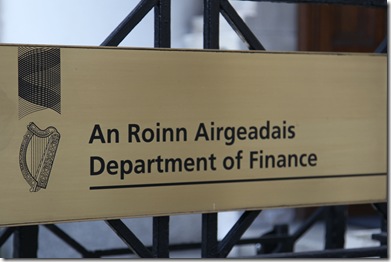
2009 09 01_0378_edited-1The stakes for Ireland have never been higher.  Generations of Irish people are extremely vulnerable after the catastrophic and systemic collapse in September 2008 of the financial system, the Central Bank and the Department of Finance - in its role of global overseer and talent scout.

Citizens would expect that the membership of the newly inaugurated Central Bank Commission would comprise outstanding and distinguished individuals whose authentic stature and relevant experience would be an asset to the Governor and Financial Regulator. They would also be expected to act as a countervailing influence to them on the basis of knowledge, insight and most importantly, credibility. This is, after all, Ireland in reform mode and the Department of Finance demonstrating how it can pull an A-team together.

The last board of the Central Bank included a menagerie of well-meaning grandees, retirees and all sorts of extremely important, loquacious people. But they were no match for the quartet of delusionary muppets that disported themselves as the Board of Irish Nationwide Building Society.

They facilitated Michael Fingleton to obtain remuneration of €16 million from 1 January 2003 until he left Irish Nationwide (with ‘holiday pay’ of €450,000, to compensate his untaken leave), the gouging by him, in 2007, of a pension fund of €28 million leaving a residual fund of €4 million (in deficit) to cover the remaining 400 employees and, of course, his €1 million bonus that Fingleton gouged when his wretched building society was utterly insolvent.

Why did the Department of Finance choose Des Geraghty and Michael Soden to be members of the first Commission?


DES GERAGHTY

Des Geraghty (67) retired as President of SIPTU in 2003 and was subsequently a member of the board of the FÁS, the Cradle of Corporate Governance.

That board was stood down in disgrace this year when an investigation by the Comptroller & Auditor General revealed outrageous breaches of corporate governance resulting in large losses to the State. There have also been allegations of fraud on the part of third-parties employed to conduct training on behalf of the agency. Trainees have been unable to obtain certification for courses they believed they satisfactorily completed and an EU audit has delayed payment of funds from that source. There are therefore most serious questions about corporate governance and trust at that agency. The Public Accounts Committee have yet to issue findings on their investigation of FÁS.

It is not at all clear if Geraghty has any related education, qualifications, experience, insights or understanding of the financial industry that would commend him to serve on the board of the Central Bank Commission. His passion is poetry and he has published a couple of books.

What particular reform qualities will Geraghty be bringing in his kit bag from Baggot Street? How about credibility with the EU Commission, business process expertise and know-how, a skill in analysing budgets and overseeing subsequent expenditure? Perhaps he qualifies as the centurion guard of corporate reputation and the ‘men-in-red-braces’ who determine credit ratings, interest rates on sovereign debt, credit availability, bond spreads will be suitably impressed, despite their coldness from time to time. Those who expected to receive certificates of accomplishment for training from FÁS could be skittish about his capacity to represent the interest of the consumer in his new role.

Mr Geraghty, of course, would also have an unambiguous measure of the Department of Finance following the negotiation of the Rody Molloy ‘kiss-and-goodbye’ package (+car) and he will have observed how Pat Neary has been saved from distressing penury while the population at large are about to be pistol-whipped in the next Budget to fund his exit from College Green.


MICHAEL SODEN

Michael Soden seems to like the sound of his own voice and the megaphone he uses to bellow at café society.

An exponent of the ‘Why Not? Academy of Lateral Thinkers’ he suggested three days after his appointment to the Commission that if everyone in Ireland worked a 5½-day week there would be a 10% linear improvement in national productivity.

His most recent rambling was ‘Let’s quit the EU and join the US’ thus demonstrating his capacity to prostitute our national sovereignty.

The Department of Finance have now given him a pulpit and a mandate from which to bellow through his megaphone and entertain the high-polloi of the EU, the European Central Bank, the IMF, the rating agencies and the men-in-red-braces. Perhaps if a capacity to entertain was the criteria of the Department of Finance based their choice of candidate on, it is strange that they overlooked personalities such as Twink, Sinead O’Connor, Bob Geldof and Fr Brian D’Arcy as potential members of the Central Bank Commission. Given infinite reach of Soden’s wisdom perhaps Jay Leno could have enriched the Soden’s rose-tined and starry-eyed US perspective.  What can Soden offer that they could not?  They are all entertainers!


National Australia Bank

Soden was one the top-13 executives at National Australia Bank (The National) from 1994 to 2000. He reported to Donald Argus, Chief Executive and Managing Director from 1989 to 1999 and to Frank Cicutto who succeeded Argus in 1999.  Argus was a director of National Irish Bank (NIB) and National Irish Bank Financial Services from the time it became a wholly owned subsidiary of The National in 1987.

The High Court appointed Inspectors to investigate NIB in March 1998.   This took six years to complete and covered a series of major transgressions of company law from 1988 until 1998.  NIB was severely criticised in the Final Report of the Inspectors on the basis of findings of the utmost gravity, involving well in excess of a dozen persons, that were the consequence of a catastrophic lapse in the standards that customers and third parties dealing with any bank are entitled to expect.

The catalyst for the appointment of Inspectors was not the policing and enforcement competence of the Central Bank during the tenure of two Governors, the late Mr Doyle and Mr O’Connell. The incompetence of the Central Bank to police the Irish banks was exposed by the curiosity of two investigative reporters from RTE.

RTE reported in March 1998 that interest charges had been increased, without legitimate reason, and without customer knowledge in four branches. They also reported that customer fees had been uplifted in one branch in November 1989 without customer knowledge, or underlying justification. They stated that these practices were systematic within NIB and were motivated by a desire for enhanced profitability and career progression. It was these characteristics and values that attracted the vicarious patronage of Argus. It was these RTE reports which prompted High Court intervention less than a week later.

The matters investigated involved large sums of money and demonstrated a lack of commercial probity that cost NIB €64 million. The inspectors’ findings included:

  • The opening and maintenance of bogus non-resident accounts in NIB branches enabling customers to evade tax through concealment of funds from the Revenue Commissioners
  • Fictitiously named accounts opened and maintained that enabled customers to evade tax
  • CMI policies were produced as a secure investment for funds undisclosed to the Revenue Commissioners
  • Special Savings Accounts had DIRT deducted at the reduced rate, notwithstanding that the applicable statutory conditions were not observed – a curtain raiser to the establishment of the DIRT Inquiry by the Public Accounts Committee in 1999.
  • There was improper charging of fees to customers
  • There was improper charging of interest to customers

At no time prior to the appointment of the Inspectors did NIB address the issue of a potential retrospective liability to the Revenue Commissioners for tax arising from the irregularities in the operation of DIRT.

NIB, under the direction of its executive leadership in Australia, had therefore debased several major institutions of this State, including the Central Bank and the Revenue Commissioners and ruined the reputation of Ireland as a trusted, respected component of the global financial sector. What was discovered made Nigeria scam merchants’ seem virtuous, noble, respectable and trustworthy.

The response of The National to the appointment of Inspectors by the High Court was: “During the year (1998) NIB was the subject of investigations arising from allegations against certain parts of its operations. While involving unfavourable publicity, none of these investigations demonstrated widespread, or systematic, misconduct and the Bank will continue to work constructively with the authorities in order to resolve these matters” (The National 1998 Annual Report). These are the views of the executive leadership The National that included Soden at that time.

Major breaches of the Companies Acts seemed to have had as much impact on Mr Argus and his leadership team as an intermittent episode of trapped wind, corporate heartburn and halitosis. There was no evidence of Matthew Elderfield’s vision of intrusive supervision between 1988 and 1998 in the relationship between The National and its own wholly-owned subsidiary in Ireland.

When the Inspectors’ Report was published in 2004, after Soden left Bank of Ireland, The National issued its second press release on the subject of the NIB investigation. It stated that “the Director of Corporate Enforcement in Ireland today (30 July) released the Report of the High Court Inspectors into certain past business activities of NIB. The events go back a long time” - an antiseptic response to what transpired to be a plague of rapidly deteriorating bad behaviour as Irish banks engaged in ‘follow-the-leader’.

The Director of Corporate Enforcement was subsequently to begin a process to seek the disqualification of nine senior managers of NIB. Disqualification prevents the person concerned from acting as an auditor, director, or other officer, receiver, liquidator or examiner – or be in any other way, whether directly, or indirectly, concerned, or take part, in the promotion, formation or management of any company or society registered under the Industrial and Provident Societies Act 1893 to 1978.

Mr Justice Peter Kelly stated on 26 October 2005 with respect to NIB “the edifice of banking is built on a foundation of trust. On the Inspectors findings there was a breach of trust by dishonesty. The operations were carried out over a period of years in a deliberate fashion on the part of the Bank”.


Bank of Ireland

Soden was employed by Bank of Ireland from 1 September 2001 until 29 May 2004, a period of 1,001 days, for which he received remuneration of €4.79 million. He joined the Court on 11 September 2001 and became Group Chief Executive on 1 March 2002. Soden held this position until he abruptly left the employment of Bank of Ireland on 29 May 2004.

Soden’s career at bank of Ireland was generously described by Laurence Crowley, the Governor, on 29 May 2004, as “having made an enormous contribution” and having placed the Bank of Ireland “in a position of solid strength for future growth”.

During the 820 days that he was Group Chief Executive, 61% of total Bank of Ireland loans were in respect of residential mortgages, property, construction and commercial mortgages. How comfortably does this fit with Matthew Elderfield’s views on lending standards? Soden is also an example of the over-remunerated asset acquirer – who vigorously pursued Abbey National, the former UK building society, in 2002, until he was shunned.

Lending growth by Bank of Ireland to the Irish residential mortgage sector, under Soden, was achieved through increasing lending, from 12% to 20% of total loans to new Irish borrowers, in respect of properties with a loan-to-value ratio of between 91-95%.   Lending to new Irish borrowers in respect of properties with a loan-to-value ratio of 75%, or less, concurrently reduced from 53% to 45% of total loans to that category. Mortgages were also extended to British customers towards properties with a loan-to-value ratio in excess of 95%.  How does this practice connect to Matthew Elderfield’s views on risk management arrangements?

It clearly had catastrophic risk implications because the Irish taxpayer was forced to provide €3.5 billion to supplement its capital and NAMA will be taking over €12 billion in loans at a discount of 42%.

When describing the impact of his leadership at Bank of Ireland  Soden stated that “this very consistent performance is the result of focused management attention to the needs of our customers and clear strategies for growth.  The achievement of our strategic goals is also supported by an excellent credit culture, a commitment to the highest standard of corporate governance and behaviour”. (Group Chief Executives Operating and Financial Review - Annual Report 2003).

But it was his own hypocrisy that hastened Soden’s departure and the ‘embarrassment’ that he caused his counterparts on the Court of Bank of Ireland, - prominent individuals such as Denis O’Brien, Ray MacSharry, Maurice Keane and Richard Burrows among them. Is it realistic that Soden, as a member of the Central Bank Commission would be overseeing the effectiveness of the board member at Bank of Ireland who was a contemporary of his in 2004 when he ‘embarrassed’ his colleagues?

Embarrassment at Bank of Ireland, comes with a hefty price tag, which in this instance was €96 million, as reflected in the drop in share price from the 20 to 29 May 2004, when Mr Soden’s foibles with adult content on the internet during business hours came to light.

PERCEPTION OF CENTRAL BANK COMMISSION

Perception counts for much in the assessment of credibility the calibration of credit rating, bond spreads and sovereign interest rates. What credibility will this Commission have?  Why must it be necessary to waste time explaining its make-up?

Credibility made it possible for William Howard Taft to become the 10th Chief Justice of the United States Supreme Court eight years after he left the White House in 1913 and it was not possible for Richard Nixon to emulate him 60 years later. That would also explain why senior members of the Christian Brothers order do not appear in the leadership ranks of rape crisis centres’ located in major metropolitan locations.

Irish people deserve better from their Government and their Department of Finance.  Thoughtful consideration of what is really in the national interest is like MasterCard – priceless.

Sunday, October 24, 2010

A week in the life of an aircraft that flies to Brazil!

airbus

I flew from Paris to Rio de Janeiro on Saturday, October 16th.  The aircraft, an Air France Airbus A330-203 bore the registration F-GZCF.  I discovered on the internet that this plane has been operating since 6 June 2002 and that it is leased from International Lease Finance Corporation of Los Angeles, who happen to also be one of the many aircraft leasing companies with a base in Dublin.

I discovered that before flying me to Rio this aircraft has arrived in Paris from Conakry Airport in Guinea, West Africa.  It returned to Paris from Rio arriving on Sunday, Oct 17th and then flew to Boston.

It returned from Boston to Paris on Mon, Oct 18 and on Tue, Oct 19th it flew to Cairo returning to Paris the following day.  That Wednesday it departed again for Rio returning to Paris the following day, Thu Oct 21.  Later that Thursday F-GZCF departed for Newark Airport in New Jersey and completed its 7-day odyssey when it flew back to Paris before departing for Seattle.

My departure point from Brazil on Fri, Oct 23 was Sao Paulo Guaralhos International Airport for the 20-million throbbing city in the south-east.  This time my Air France aircraft was a Boeing 777-22BR bearing the registration F-GSPP.  During the preceding week it had visited Mumbai India, Douala Camaroon, JFK Airport New York and Santiago Chile,  When it and I parted company yesterday, F-GSPP departed fro Mexico City.

Wednesday, October 20, 2010

Where do Irish Labour stand on fiscal discipline?

The Labour Party in Ireland have been soaring in the opinion polls but remain stubbornly mute on the issue of fiscal discipline and public expenditure cuts, including, for example,  whether child benefit should, or should not, be cut. 

If Labour is to fulfil the trends in recent opinion polls the electorate need to have some clear insight and concrete understanding into how Labour, in government, intend to steer the economy.  Why should the electorate buy a pig in a poke?

A scarecrow in a fog would have offered more incisive economic leadership that our dear nation has witnessed in recent times.  The consequences are mirrored in the polls, high interest rates, indifferent sentiment and declining credit ratings.

Economic leadership includes not just the broad policy frameworks concerning public expenditure and the successful prosecution of delinquent bankers.  But it also means fielding an A -team throughout the government apparatus to execute competent economic leadership. Is it not reasonable that a prospective Head of Government could give an indicative indication of the team he will assemble to implement a Labour mandate?

I am not speaking of elected official but the myriad of non-elected appointees to boards and commissions throughout the State and, most especially, those whose profile and competence impacts on the reputation of the State in the economic arena.

Perception counts for more than people presume.  That is why we are paying through the nose for sovereign debt and why rating agencies frown on Ireland.  If Ireland does not field an A -team in all positions that have an impact on the recovery our national reputation we risk becoming an exploited, inconsequential  third-world backwater in a very unforgiving global system that will never achieve self-sufficiency.

The social welfare budget has increased in the past decade by 206% from €6.7 billion to €20.5 billion since 2000. During this decade our population increased by 19% and the consumer price index by 28.8%. Total child benefit payments increased by 291% while the number of child beneficiaries increased by 14% since 2000 to 1,156,917 in 2009.  The deficit in the Social Insurance Fund has increased from €249 million in 2008 to €2.48 billion in 2009.

Social welfare is the largest component of the budget.  Politics is about making choices.  What choices do Labour intend to offer voters?

Monday, October 18, 2010

Irish universities need new procedures when filling the top job

2009 11 04_1024 When Seán Haughey TD, Minister of State at the Department of Education and Skills, answered questions in the Dáil on its first day back after the summer recess, he put on record his ‘disappointment and disapproval of the unacceptable practice which existed in some universities of making additional payments to staff without the requisite sanction’. This extensive and very costly power-play was discovered in 2005, but only ceased in April 2009. The Minister’s statement follows the publication of a far-reaching report on resource allocation in Irish universities by the Comptroller and Auditor General . Mr Haughey also cited, in the course of his observations, the Universities Act 1997 as conferring a considerable degree of institutional autonomy on the universities’, whose salary costs alone exceed €1 billion per annum.

The chief officers of Irish universities enjoy a 10-year term of office which is exceptionally long in the context of the 7-year term that applies to most top-level public sector appointments in Ireland. The Irish universities depend on the State for virtually all funding so perhaps it is time that the President of Ireland appointed their chief officers of universities on the advice of the Government, as is the case with top-level judicial appointments. Candidates for chief officer might be appointed for a maximum of two discrete consecutive five-year terms.

Trinity College, for example, will appoint its 44th Provost in its 419 years of existence in 2011. The successful candidate will be chosen in a ballot by an electorate comprising senior academics having first secured the nomination of no less than 12 of them. Trinity College had all the characteristics and privileges of a private institution until 1952 when it accepted £35,000 in State support under the auspices of the then Taoiseach, Éamon de Valera. But its procedure for choosing a chief officer continues to have the hallmarks of an elite, private gentlemen's’ club, where females, strangers and external candidates for the office of Provost have never been successful.

If the assistant secretaries and the principal officers of the Department of Education and Skills were to choose the Secretary General of that Department by ballot, or through some other exclusively internally focused process, would that make this Department sufficiently accountable to the will of the Government and its policies and procedures aligned to the public interest?

The timing of the Trinity appointment could therefore be the catalyst for revised legislation that would overhaul the top-level appointment process in all Irish universities, thus ensuring that he who pays the piper would actually call the tune. This revision might also ensure that the Tánaiste, Minister Haughey and their successors are less reliant on exclamations that “the universities should be ashamed of themselves” and more emboldened, like President Medvedev of Russia in his search for accountability, when he summarily dismissed the long-serving, but immensely powerful Mayor of Moscow, following a summer of pervasive choking smog in that city, which his worship did not do enough to alleviate.

Sunday, October 17, 2010

Irish bank bail out costs escalate


IMG_6260_edited-1 The cost to the Irish State of capitalising credit institutions at September 2010 was as follows:


€ Billion Cost of acquiring shares Preference Shares Promissory Notes Total State Capital at Sep 2010
Anglo Irish 4.0   18.88 22.88
AIB 0.28 2.5 -   3.78
BOI 1.95 1.8 -   3.75
INBS 0.10 - 2.60   2.70
EBS 0.10 - 0.25   0.35
TOTAL 6.43 5.3 21.75 33.48


The cost of future assistance is estimated at €12.26 billion

€ Billion Projected Future Assistance Return on Investment to date Overall
State Capital
Anglo Irish 6.4   29.28
AIB 3.7     7.48
BOI - -0.49   3.26
INBS 2.7     5.40
EBS 0.0     0.35
TOTAL 12.8 -0.49 45.74


A substantial proportion of the shares in Bank of Ireland have been converted into preference shares leaving a balance of ordinary shares amounting to €1.95 billion.

The State continues to hold €3.5 billion in preference shares.

The National Pension Reserve Fund is to underwrite a placing and open offer of €5.4 billion in AIB.  If necessary, the NPRF underwriting commitment will be satisfied by the conversion of up to €1.7 billion of its existing preference shares in AIB into ordinary shares. along with a new cash investment.for the balance of €3.7 billion in ordinary shares.

The foregoing assumes that the AIB investment in M&T Bank Buffalo New York will be sold and that other assets will also be disposed in due course.  If there is a shortfall of capital by 31 March 2011 any shortfall will be met by the conversion of a proportion of the remaining €1.8 billion of preference shares. 

Future capital needs of EBS are to be met from negotiations with several parties about its future. 

Future transfers into Anglo Irish Bank and Irish Nationwide Building Society are classified as capital transfers and a directly returnable investment.

All investments to date in AIB and BOI have been provided by the National Pension Reserve Fund.

Radical action for ‘a new Irish beginning’, a view from Brazil

Impanema Speaking at a business conference in Dublin last week on the topic of radical action for ‘a new beginning’ , the former Limerick academic, Dr Ed Walsh, offered what he considers to be far-reaching suggestions to ‘avoid bricks being thrown through windows’. He once again advocates a national government to include two non-elected businessmen, in whose inspirational political skills Dr Walsh seems to have unsurpassable faith.

The centre of gravity in a democracy is the citizen. How could a pair of unelected businessmen achieve solidarity, fidelity and unity of purpose with the electorate from whom they would have no mandate?  Advocates should closely observe Brian Cowen to realise what happens to a Taoiseach who does not have his own mandate.

Walsh criticises the lack of talent in electoral politics. All are frustrated by a lack of inspirational leadership in Ireland’s affairs. Leadership has been replaced by ‘partnership’ that has given lobbyists, lamentable hangers-on and other back-scratchers so much illicit influence and access that the steering apparatus of society has become so rudderless, dysfunctional, unaccountable that our economy is now unsustainable. Outcomes of decisions are self-serving and fuzzy. Too many citizens feel disenfranchised by vested interests. Lobbyists are voracious parasites, without a social conscience, whose role is to eat the flesh of society. The most important piece of kit that a lobbyist has is a shrill whinging voice that threatens Armageddon and the begging bowl. The latter will always be empty because, if it were full, the raison d’être of the lobbyist would disappear causing his, or her, cash flow to vanish!

We are also observing the ‘cute whore’ approach to the use and abuse of the legal system by those attempting to obscenely enrich themselves on a questionable moral premise and, too often, at great cost to the rest of society.  Dignity and respect is earned, not conferred by judicial decree.

We are at the bottom of an economic mineshaft surrounded by the impenetrable rock of deteriorating credit ratings, wide sovereign bond spreads, penal interest rates, high deficits and collapsing tax revenues. Our society must take stock of the types of leadership that will deliver a reliable rescue capsule at the next election. We do have daylight, fresh water, meagre rations, contact with the outside world and an ability to think creatively.

Partnership must be replaced by values that ignite solidarity and a sense of common purpose where citizens feel that is they who are given priority, not influence peddlers. A government cannot be all things to all people.  The retiring President of Brazil, Luiz Inácio Lula da Silva successfully demonstrated this since 2003. 

The social partners must come out of the closet and realise that they are in a powerless relationship and, like an extra-marital affair, this relationship padlocked by paralysing ambivalence.

Ireland’s aspiring political leaders could learn some fundamental lessons in leadership from Mr Luis Urzúa, the shift leader of the 33 men who escaped from the mine in Chile last week. They were trapped for 17 days before anyone above ground could make contact with them. Urzúa set up a regime that was rooted in solidarity, rather than partnership. His strength was in being able to analyse the situation; make a diagnosis and devise a plan of action. This instilled a sense of structure and order among the miners who has been overcome by desperation after the cave-in revealed a wall of rock hemming them in. The miners relied on the principle of one-man, one-vote to make decisions, building a sense of unity to overcome periods of severe strain underground. Mr Urzúa showed that sound training and clear thinking are vital to crisis management and achieving this happy ending.

Jim Lovell, the Apollo 13 commander who helped steer his spacecraft to earth 40 years ago when it lost power after an oxygen tank burst in space, is now 82 years old and he recently stated “if we did not do anything and waited for a miracle I might still be in space now. God helps those who help themselves”.

Our approach to the future ought to recognise the primacy of helping oneself, self-sufficiency, personal initiative and social solidarity, not overarching greed, the conniving skulduggery of the 'cute whore' and impotent partnerships which deliver nothing of sustainable value, or impact, and are increasingly disconnected to those they proclaim to represent.

Tuesday, October 5, 2010

Ministerial transport in Ireland not always eco-friendly!

The Irish Government consists of 15 cabinet minister and one non-cabinet minister with visiting rights at cabinet meetings.  Each is provided with a vehicle and two Garda drivers on a 24-7 basis  but not all vehicles are environmentally friendly.

The current fleet is:

Vehicle Make No. of Vehicles Minister Beneficiary CO2g/KM
Citroën C6 1 Children & Youth Affairs 311
Audi A6 1 Health & Children 240
Mercedes S320 1 Taoiseach 228
Volvo S80 1 Tourism, Culture & Sports 224
Audi A6 5 Tánaiste, Education & Skills
Justice & Law Reform
Transport & Marine
Social Protection
Agriculture, Fisheries & Food
223
Mercedes E320 1 Finance 194
Lexus GS 450h 2 Defence
Community, Equality & Gaelteacht Affairs
186
BMW 520 2 Enterprise, Trade & Innovation
Foreign Affairs
165
Toyota Prius 2 Environment, Heritage & Local Government
Communications, Energy & Natural Resources
104

The running cost of the ministerial transport service was:


€ 2008 2009
Salaries of drivers 3,006,781 2,764,119
Fuel    147,695    127,254
Maintenance     86,773      98,541
Purchases   367,277          NIL
TOTAL 3,608,526 2,989,914

Sunday, October 3, 2010

Pleasing the ‘men-in-red-braces’ means a 5½-day working week in Ireland

Ireland demonstrates infinite compassion and endless patience when it comes to indulging the fantasies of imbeciles, hypocrites, morons and failed bankers, whose genius would be better employed exploring options for their own euthanasia.

It was in this frame of mind that I listened to a commentator on RTE radio expound the virtues of a 5½-day working week so as to achieve a 10% gain in national productivity.   This ludicrous suggestion is intended to imply that the Irish would be able to demonstrate to the men-in-red-braces, who lead opinions in the international financial markets that our road to economic salvation is soundly mapped.

The fundamental reason, of course,  for this brazen gesture is to pay for the banking delinquency inflicted by the person advocating it, among others . His mathematical genius and visionary leadership has caused this country’s taxpayers tens of billions of euro in bailout money and this wretched wimp has the odious gall to declare that the proletariat should work longer hours.

We definitely need to think outside the nappy.  Perhaps we should also lengthen the calendar week to 9 days; work 8½- so as to increase national productivity by 28%.

We could jettison the European Working Time Directive and all Health and Safety legislation and guidelines. We could extend the calendar week to 9 consecutive days and even consider working for 8½ of those and then be able to demonstrate 28%. There could also be a unilateral declaration to ban hedonism in each and all manifestations.

One of the difficulties with this type of intellectual gymnastics is that working for excessively prolonged periods results in fatigue which decreases work performance. It has been demonstrated in academic research that human error by operators doubles when fatigue sets in and there is a misalignment of circadian phase – the rhythmic biological cycle that recurs at approximately 24-hour intervals

It may even quadruple as workers reflect that cause of their fatigue is the obligation to restore a bust banking system.

Monday, September 27, 2010

Changchun’s Irish visit a boost to Sino-Irish relations

IMG_6330-1_edited-1 His Excellency Li Changchun, the fifth ranking of nine-member Standing Committee of the Political Bureau of the Communist Party of China – the only political party in the country, visited Dublin today.  The CPC was founded on 1 July 1921 and has almost 78 million members across 3.3 million branches. Over 71% of the membership is under 35 years of age and 21.7% are female members. Li was promoted to the Politburo at the age of 54 in 1998 – making him the youngest person ever to achieve this role.

China has become the 3rd largest economy in the world and having achieved a 9.1% increase in GDP in 2009 is poised to achieve an 8% growth this year.

Despite rapid growth China is still a developing country and although heavily populated it faces problems in the areas of employment, pensions, social security, housing and healthcare. But, according to Li, China is opening up and attaching great importance to intellectual property rights.

Ireland and China established diplomatic relations in 1979.  Ireland has a trade surplus with China and exports to China increased by 17% last year.  China is seeking to secure cooperation with Ireland in fields such as telecommunications, bio-pharmaceuticals, clean energy and other fields.  It is also interested in initiatives to advance culture, education, media and tourism.  Li is the propaganda chief of the CPC.  He mentioned a need to fight against trade and investment protectionism, and to work jointly in areas such as climate change and economic recovery.

Sunday, September 26, 2010

Fine Gael’s approach to the presidential election brimming with vision

A brim is the upper edge of anything hollow.  The verb brimming describes something that is full to the brim – and Fine Gael are certainly not brimming with vision when the issue is the next presidential election.

A comment this morning on the Marian Finucane RTE 1 radio programme by Brian Hayes the Fine Gael TD to the effect that ‘an agreed candidate’ might be an option for the next President of Ireland almost induced an episode of collective projectile vomiting in our household.  

Ireland has been afflicted with a Taoiseach who has no public mandate and the suggestion that a so called ‘agreed candidate’ is an appropriate means of determining the next President is an appalling, ugly vista that totally compromises our fundamental democratic rights and falls within the same retarded school of political thinking that advocates gender quotas.

The very least the nation should expect is that the major political parties are capable of sponsoring a viable candidate and if they are unable to do so their chances of governing effectively are correspondingly weakened.  Do  Fine Gael not have the balls to play this game on the electoral playing field?  That need not exclude Fine Gael sharing the endorsement of a candidate but the person nominated must be one of several candidate who must contest a presidential election.

A major weakness in the presentation of those who have tilted at the prospect of a nomination so far is their reluctance to state clearly at a high level at the outset what their credentials are to become head of state. 

Therefore, how can a voter deduce if someone from Kerry who was once president of the GAA is an attractive choice to become President of Ireland because he offers not an inkling as to how he would execute the office?  Does writing about agricultural issues in the media and representing subsidy-hunting farmers in the European Parliament constitute a satisfactory launching pad for the presidency, especially when nothing else is known about the person concerned?  Will the country, where the median age of the population is slightly under the age of 35 years embrace the concept of a candidate who would be 77 years of age at the end of the next presidential term excite voters? 

There will be a gap in each and every instance between the background and current activities of these individuals and their capacity to be a successful president.  There is no such thing as a ready-made presidential candidate.  That is why each one must address the central question as to why he, or she, is worthy of public trust in this supreme office.  Imagine if the nation is be afflicted with another ‘George Lee’ type whose credentials for office are ‘wonderful’ but whose capacity to serve in elected office was pathetic.

It is not for me, or any other commentator, to provide the ultimate answer and that is why there must be a presidential election which offers a choice of decent, attractive candidates.  I trust that Mr Hayes observation is the first and last occasion I hear talk of ‘an agreed candidate’. 

Saturday, September 25, 2010

Tom Elliott and the GAA

It is noteworthy that the first days of the leadership of the Ulster Unionist Party by Tom Elliott are characterised by what he will apparently not do rather than what he is determined to accomplish.

Mr Elliott is skittish about attending GAA matches. He was also churlish about supporting Down in the All Ireland final.  If Mr Elliott was really shrewd he would realise, as the incoming leader of a political party that has been consigned to the margins, no longer centrally relevant to society’s destiny and whose dwindling, ageing membership grows more sedentary and apathetic, that he has much to learn from the GAA. A new leader has political capital in the bank.  A new leader ought to be abundant with energy, vision and novelty, not sclerotic, like the centurion guard of a tribe threatened with extinction.

The Ulster Unionist Party is 21 years younger than the GAA – a callow youth in comparison, but, in common with many political parties, it achieves little traction with the age group that the GAA so expertly attracts and captivates.

The GAA has a legacy extending back 125 years and claims a million members, mostly young, able and ambitious individuals whose genius and ingenuity will define the potential of Irish and Northern Ireland society for coming generations. The GAA is an organisation that has thrived on change, embraced diversity and repositioned itself at the mainstream of Irish society, especially among young people and is strengthened as a consequence.

If Mr Elliott believes that he has the imagination and capacity to reinvigorate his moribund party he could also learn much from the organisational skills and grass-roots savvy of the GAA and, especially, how it has successfully navigated fundamental change to its policies and rules without jeopardising its own existence. He could learn how it attracts, inspires and fosters the loyalty of tens of thousands of young members. But to gain these insights personally he must earn the trust of those who can describe the insights and experience. That involves steering his sturdy Fermanagh feet onto the terraces of various GAA grounds from time to time. The fact that Sir Edward Carson enjoyed hurling and was a member of Cumann Iománaíochta at Trinity College prior to the founding of the GAA should not make such a proposition an unduly distressful ordeal for Mr Elliott.

The passage of the British-Irish Agreement in the 19th Amendment of the Irish Constitution on 22 May 1998 by a majority of 93% of those voting means, unequivocally, that there is no threat to the political interests that Mr Elliott represents - other than through the free will of the people.

But if Mr Elliott’s political legacy is to be constrained by archaic shibboleths and yesterday’s thinking then he might as well hide and record his thoughts on his office voice mail to assure his followers that he has nothing new or inspiring to say to them and that their destiny under his leadership will not mean they become more self-sufficient, more prosperous, or more self-confident.

Wednesday, September 22, 2010

Ireland: Borrowing money to give it away

Mr Justin Kilcullen of Trocaire has severely chastised the Government (The Irish Times Opinion & Analysis, 20 September) for ‘reneging’ on its commitment to spend 0.7% of GDP per annum on international aid, a target set by the UN a decade ago.

The Irish Government is spending €535.3 million on this programme in 2010.  It spent €422 million on development aid in 2002 when our tax revenues were last in the region of €30 billion, when the exchequer surplus was €94 million and our national debt was €31 billion.  The government has spent over €5.8 billion altogether between 2001 and 2010, so even if we stand indicted in the eyes of lobbyists, Irish people have pulled their weight on the delivery of ‘real change’ to the less privileged.

But the view of the aid agencies is that the government needs to commit €1.1 billion per annum for an on-target performance.  They exhort the Government to ‘find the money’ and, in the classical language of a lobbyist, ‘to set out clearly defined, year-by-year steps’ to meet their aspirations – in circumstances of unprecedented turmoil and volatility.  The Government is also asked to introduce new legislation so that Ireland can lead the world in the safeguarding of aid commitments from any and all prevarication, doubt and uncertainty.

This approach would be a difficult challenge at any time because Peter has to be robbed to pay Paul, but when government expenditure is €54 billion and government income is €30 billion that challenge becomes even more elusive because the only source of money is from international moneylenders whose penal rates of interest are a reflection of their below-par confidence in the country’s capacity to recover from the brutal mauling inflicted by our banks and building societies and their capacity to regain functionality.

It still appears that a great deal of money spent on aid by Ireland is based on the ‘black baby principle’ of merely giving it away with no economic advantages being conferred on our economy.  Other countries spend aid on the provision of long-term infrastructure and assets by their own enterprises so as to stimulate self-sufficiency,  not nurture chronic and infinite dependency and, critically, to minimise exposure to bribery, corruption and price gouging – a widespread  experience anecdotally reported following the horrific earthquake in Haiti.

Turning to the future, how can Ireland meet the ambitions of those seeking to alleviate world poverty if our policy is really founded on the practice of borrowing money to give it away and the scale of the expenditure bears no relationship to our capacity to afford it?  It would be preferable for Ireland to participate in the international aid arena with integrity and modesty rather than indulging our vanity and always seeking a status and recognition in the eyes of the world that is beyond our capacity to sustain. Finally, why should our values be shaped dictated by lobbyists who have no mandate beyond the perimeter of their own T-shirt and not the elected Government who are presumed to act vicariously and in the best interests of the people?

Thursday, September 9, 2010

Rescue remedy needed for training and education system

The viability, reputation and stature of our national training and education enterprise is sailing like the Titanic en-route to the iceberg and there are no life jackets on board.

Despite recurring and widespread allegations of systemic malpractice and accounting failures at FÁS, SIPTU announce glibly that the ‘problems’ at FÁS can be overcome, a perspective not apparently echoed by IBEC. Is this a case of mutual recognition by birds of a feather, or does it merely imply that SIPTU has a higher than desirable tolerance of mediocrity and slovenliness and an aversion to change and radical reform?  FÁS is a creature of a social partnership process that has self-destructed as a result of insular thinking, incompetent, delinquent and politically compromised leadership. The best days of FÁS are behind it and only those with deep vested interests, most precious to themselves, refuse to recognise this while those most effected deserve a much more enlightened and inspiring response.

Secondly, a stronger level of Government supervision is urgently needed over the plethora of private third-level colleges emerging in this country. This could take the form of an operating licence reflecting the conformity of its teachers and courses to designated national standards.  Some of these so-called colleges are purely money-making rackets promoted by individuals with no background in education and no substantial personal academic credentials. They should be immediately banned from advertising courses that have no Irish State accreditation rather than playing on the desperation and gullibility of an unsuspecting public, presumed to believe that any entity with the initials C D in its identity automatically has the prestige and resourcefulness of a distinguished university. When there is incisive and scathing official criticism of a private college it is no defence whatsoever to state that such criticism is "not as positive as we might have hoped".

Thirdly, the realisation that 40% of our adult population struggle with primary school maths and that 10% of the candidates for ordinary maths in the 2010 Leaving Certificate failed is a symptom of a fundamental failure in leadership at an institutional and also at a political level. If that trend is not successfully arrested the prospects of our society being able to sustain the standard of living it aspires to will be sorely compromised and those adversely affected will find it increasingly difficult to obtain meaningful work at home and abroad because such a wide range of skills are based on some understanding of maths and mathematical relationships.

Wednesday, September 1, 2010

Mortgage arrears escalate

2009 11 28_1130_edited-1-copy Mortgage arrears in Ireland continue to climbed by close to 40% while the overall number and value of mortgages declined by 0.6%.

Total Mortgages Number Balance Outstanding € Average Mortgage €
Sep-09 794,609 118,648,748,000 €149,317
Dec-09 792,885 118,342,812,000 €149,256
Mar-10 791,047 118,057,227,000 €149,242
Jun-10 789,814 117,717,554,100 €149,045
Change
Sep 09-Jun10
-0.6% -0.8% -0.2%
       
In arrears
91-180 days
Number Balance Outstanding € Arrears €
Sep-09 8,504 1,589,274,000 47,684,000
Dec-09 9,418 1,745,326,000 52,856,000
Mar-10 10,504 1,943,632,000 50,388,000
Jun-10 11,641 2,142,685,000 72,386,000
Change Sep 09 - Jun 10 36.9% 34.8% 51.8%
       
In arrears
180 days+
Number Balance Outstanding € Arrears €
Sep-09 17,767 3,238,39Bal5,000 306,730,000
Dec-09 19,185 3,588,718,000 361,367,000
Mar-10 21,817 4,160,047,000 414,165,000
Jun-10 24,797 4,805,837,000 486,527,000
Change Sep 09 - Jun 10 39.6% 48.4% 58.6%
       
Total Arrears Number Balance Outstanding € Arrears €
Sep-09 26,271 4,827,669,000 354,414,000
Dec-09 28,603 5,334,044,000 414,223,000
Mar-10 32,321 6,103,679,000 464,553,000
Jun-10 36,438 6,948,522,000 558,913,000
Overall Change
Sep 09 - Jun 10
39% 44% 58%

Sunday, August 22, 2010

The travails of Senator Ivor Callely continue

Leinster House When the Select Committee on Members’ Interests of Seanad Éireann found that Senator Ivor Callely had misrepresented his normal place of residence for the purpose of claiming €81,500 in allowances I contacted the Committee.

I asked on 24 July if the Committee could confirm if Senator Callely has honoured the clear undertaking given in his evidence on 25 June 2010 that he would reimburse, or repay, any overpayment of allowances?  If this undertaking has not been honoured, what steps do the Committee propose to take in the light of their own determination and findings on 14 July 2010 to preserve public confidence in the Seanad and its members and within what time frame will this issue be equitably resolved?

I pointed out that there are, according to statistics provided by the Revenue Commissioners, over 900,000 people in our workforce of 1.8 million that earn €20,000,or less, per annum.  It would take the total income tax deductions in a fully year of over 750 of these men and women to fund the allowances that Senator Callely claimed from his second house in County Cork that were the subject of the Committee’s investigation. 

The Clerk of the Committee replied that the repayment of any allowance is now a matter for Senator Callely and the authorities in the House of the Oireachtas Service and the Committee has no further role in this matter.

Senator Eugene Regan, of Fine Gael, is a senior counsel.  He wrote an opinion article on the Callely issue in The Irish Times on Saturday, 21 August titled ‘Callely not out of the woods on suspension’.

Two points caught my eye:

  • Section 10 (1a) of Ethics in Public Office Act 1995-2001 gives the Committee the power to refer a matter under investigation to the Director of Public Prosecutions.  The author states that this provision not only empowers the Committee, but obliges it, to refer a matter to the DPP, if the Committee consider an offence may have been committed.
  • Section 28 (2)(c)(ii) of the Ethics in Public Office Act 1995, as amended by the Standards in Public Office Act 2001, provides that where a committee reports and a resolution is passed suspending a member for a specified period and where the breach in issue is continuing, then the member is suspended “in addition … until such time after the expiration of the period specified … as he, or she, takes the steps specified … to secure compliance”.

Senator Regan opines that the Seanad is judged by the citizens not merely on the transgressions of individual members but on how it is prepared to deal with transgressions and how prepared it is to exercise the powers available to the full.  His point is well made.

Monday, August 9, 2010

Irish households owing less and saving less

This is a quick overview of the current status of the deposits and indebtedness of Irish households.

INDEBTEDNESS

June Mortgages €M Other Loans €M Total €M
2010 107,677 32,514 140,191
2009 114,306 33,637 147,943
2008 121,260 30,030 151,290
2007 116,434 27,728 144,162
2006 104,897 23,743 128,640

The mortgage figure does not include €37.8 billion outstanding in respect of securitised mortgages.  While overall indebtedness is €10 billion less than it was in June 2008, it is €12 billion higher than it was was in June 2006 and this trend must be seen in the context of a severe increase in unemployment.

DEPOSITS

June Deposits €M Monthly Transactions 
€M
Ratio of Deposits to Loans outstanding
2010 97,253 -581 69.3%
2009 98,462 -135 66.5%


Household deposits are €1.2 billion less in June 2010 than in June 2009.

The negative monthly transactions in each of these months can be viewed in the context of increases in deposits in the prior three years.  Deposits increased by €124 million in June 2008; by €634 million in June 2007 and by €1,572 million in June 2007.

Saturday, August 7, 2010

Pakistan’s President flees a major humanitarian crisis to sip tea at Chequers

Asif_Ali_Zardari_-_2009 There are vey few countries whose citizens are abandoned by their Head of State at time of widespread distress and crisis.  The President of Pakistan, Asif Ali Zardari, took himself off on a 5-day soiree to London while those of his citizens that have not been drowned are floundering in flood water, breast-deep.  This very important man is the widower of Benazir Bhutto, who served twice as prime minister and was assassinated in December 2007.  He is also reported to be the 5th richest person in Pakistan

Meanwhile, the Irish people have been bombarded with advertisements this week to provide succour.   David Cameron must have been deeply impressed with this visiting personality cult but Cameron would also know that were he to abandon the Brits in a crisis of similar gravity his  tenure as prime minister would come to a very abrupt halt. 

The 11th President of Pakistan maybe very rich and very privileged but he is a disgrace.  He has treated his office and his people with contempt. Spineless leaders are bereft of priorities formed by empathy and basic moral authority.

I saw this pathetic weasel of a man speak on BBC Television last night and it is a long time that I have listened to such inconsequential waffle and blather as he explained the significance of his visit to the UK.  He came across as an empty-headed, vain, self-absorbed fool who is wholly disconnected with his own people and whose capacity to deliver anything of value anywhere in the world is severely compromised.

Genuine leaders display loyalty to their own people, especially  at a time of severe distress and their priorities and presence are with them.  They deal with a crisis directly – even if that is only a matter of providing moral support through their presence.  Is there any tragedy in Pakistan that would keep this naïve clown at home, or is his infinite vanity and pompous nature such that he resides in a bubble above the aura of human distress and misery? 

Perhaps he should be  reminded of the international travel pattern of Nicolae Ceausescu, especially his very important trip to Iran on 18 December 1989 and the consequences of that episode of presidential delegation.

His ambassadors ought to make a public statement as to whether the people around the world should open their purses and wallets while President Ali Zadari behaves as he does.  How much of Ali Zadari’s personal wealth will be donate to the alleviation of this crisis, as he is reputed to be one of the five richest people in your country and will the amount of his donation be a matter of public record, or does he also delegate that matter to the UN? 

Thursday, August 5, 2010

The World has arrived in Dublin

2010 08 05_4664_edited-1 The World has dropped into Dublin.  This is a cruise ship with a difference because it is the first ever residential cruise ship.  Built in Oslo in 2002, it has 166 residential units that sell in a price range from €500,000 to €10 million for a suite that can accommodate up to 12 people.  One, two and three bedroom residences are available.  Monthly dues start at €20,000 to cover travel and overheads, including meals from the liner’s four restaurants, deli and gourmet grocery store.  The owners of these residents enjoy a net worth from €5 million+.

The vessel’s tonnage is 43,524 gross.  It is almost 197 metres long and 30 metres wide. 

The World departs for Cork on Sunday, 8 August and for the remainder of the year its itinerary will include Faroe Island’s, Greenland, Iceland, Newfoundland, Boston, Fort Lauderdale, Rio de Janeiro, Montevideo, Buenos Aires and Christmas will be spent on an Antartica expedition.

The New Year will shepherd the fjords of Chile, the west coast of South America with many 5-day stops en route before reaching the Panama Canal in March.  The voyage then proceeds around the Caribbean and up the east coast of the US, stopping at New York before heading to Portugal, Bordeaux, London, Edinburgh by mid June.  From there the vessel proceeds on a tour of Baltic ports including Helsinki and St Petersburg before heading to Amsterdam, the Mediterranean and onwards to Capetown, South Africa for Christmas 2011.